Mining is rethinking safety
Mining leaders are redefining what good safety performance looks like. Rather than relying only on measures such as completed permits, audits or safety observations, they are increasingly focused on one question: Are the critical controls designed to prevent major hazards actually working when they are needed most?
It’s a profound shift for the sector, which is undergoing a period of relentless operational change. New technologies, automation initiatives, remote operations and evolving production demands continue to reshape how work is performed. Expanding asset networks, geographically dispersed sites, contractor workforces, evolving regulatory requirements and growing volumes of operational data have made it not only harder for leaders to see where they’re at risk, but more difficult to demonstrate their safety controls work.
More data doesn’t mean more confidence
Mining companies have more operational and safety data than ever before. The challenge is no longer collecting information. It’s turning that information into confidence that critical controls are functioning as intended.
Recent Verdantix research highlights how the industry is responding:
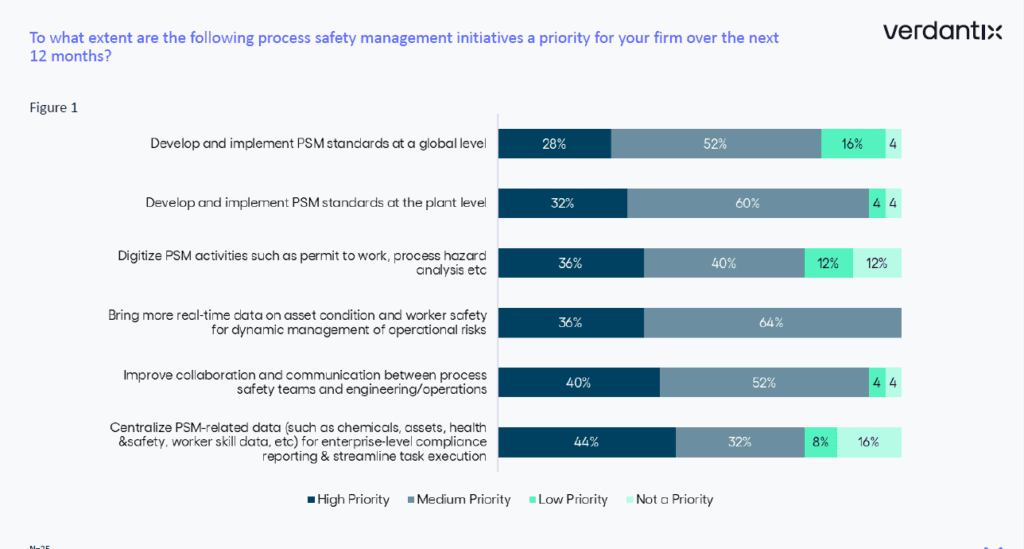
“Among mining, metals and minerals organizations, 76% identify digitizing process safety activities such as permit-to-work and process hazard analysis as a medium or high priority. An equal proportion prioritize centralizing process safety data, while every respondent rates improved collaboration between process safety, engineering and operations teams, along with access to real-time operational data, as a medium or high priority.”
Source: Verdantix, Global Corporate Survey: Industrial Transformation Budgets, Priorities And Tech Preferences, 2026
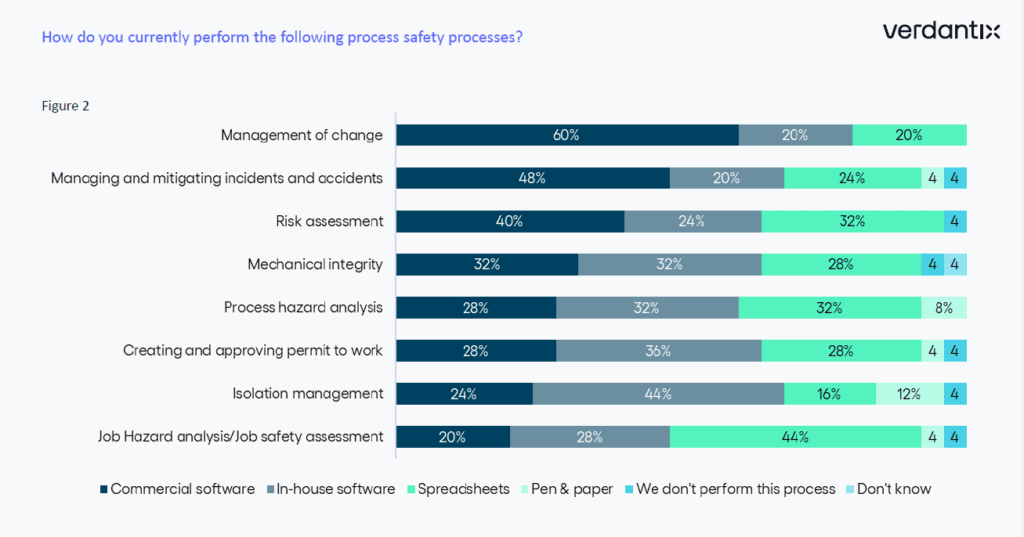
These findings suggest mining organizations are shifting their focus from simply digitizing individual safety processes toward creating connected operational risk management capabilities. The goal is to improve visibility into whether critical controls are effective. Yet execution has not fully caught up with these ambitions. While many organizations use commercial software for incident management, management of change and risk assessment, spreadsheets and disconnected tools continue to play a significant role in permit-to-work, job safety analysis and isolation management.

Source: Verdantix, Global Corporate Survey: Industrial Transformation Budgets, Priorities And Tech Preferences, 2026
As a result, critical safety information often remains fragmented across systems, teams, and sites.
This fragmentation limits visibility into operational risk and makes it more difficult to verify that critical controls are being applied consistently across increasingly complex operations. Without an integrated view of work, assets, and risk, organizations struggle to move beyond documenting controls to demonstrate that they are effective in practice.
What leading mining organizations are prioritizing
The latest Verdantix Global Corporate Survey confirms that mining organizations are moving toward this more integrated approach to operational safety. Respondents identified four key priorities:
- Improving collaboration and communication between process safety, engineering and operations teams
- Bringing more real-time data on asset condition and worker safety for dynamic management of operational risk
- Digitizing core PSM activities
- Centralizing safety information for enterprise-wide visibility
Source: Verdantix, Global Corporate Survey: Industrial Transformation Budgets, Priorities And Tech Preferences, 2026
These priorities reflect a broader shift in how mining leaders think about safety. Rather than managing process safety, Control of Work, asset integrity and operational risk as separate disciplines, organizations are looking to connect information across these functions to strengthen risk visibility, improve decision-making and increase confidence that critical controls are working as intended.
Controls must be verified, not just implemented
In mining, the distinction between control implementation and control assurance matters greatly. A control may be defined in a risk register, embedded within a procedure or linked to a permit-to-work process. But its effectiveness can still be compromised by operational changes, communication gaps, incomplete information or inconsistent execution.
Without visibility into how controls are performing in practice, mining organizations risk making decisions based on assumptions rather than current operational realities.
Contractor safety is one example of why control assurance has become increasingly important. According to the ICMM, contractor fatalities accounted for 69% of fatalities reported by ICMM member companies in 2025. As contractors work across multiple sites and organizations, they must navigate different procedures, work practices and permit systems. This operational complexity can make consistent execution of critical controls more challenging, reinforcing the need for standardized processes and better visibility across high-risk work.
Addressing this challenge requires more than digitizing existing processes. It requires creating consistent ways of working across sites, teams, and individuals. Standardized digital workflows can help reduce process variation, improve communication, and provide greater visibility into whether critical controls have been completed before hazardous work begins. For contractors working across multiple operations, consistent processes and familiar digital tools reduce complexity while helping ensure critical controls are verified before work begins.
As Iain Mackay, Group Vice President at Sphera, explains:
“When contractors work across multiple operations using similar Control of Work systems, they encounter more consistent workflows and expectations. That reduces variability, simplifies execution, and helps ensure critical controls are applied consistently wherever work takes place.”
This consistency helps organizations strengthen control assurance while simplifying work for contractors who move between operations.
Safety can no longer operate in silos
The new safety objective in mining is not simply to collect more data, but to create a more complete understanding of how risks are evolving and whether the controls designed to mitigate them remain effective.
The shift is not that safety has become more important; mining has always taken it seriously.
What is changing is how organizations manage it. As operational complexity grows, leaders are moving toward connected safety models that integrate Control of Work, process safety, asset integrity and operational risk to create a shared view of risk and strengthen confidence in critical control effectiveness.
Industry discussions increasingly reflect this shift. According to David Ross, Director at Sphera:
“Mining organizations rarely describe their objective as simply ‘digitizing permit-to-work’ or other process safety activities. Instead, they are looking for ways to make safe work the standard way of working—reducing operational risk, improving consistency and ensuring critical controls are applied every time work is performed.”
In regions such as Australia, where mining regulations place a strong emphasis on managing major hazards and demonstrating effective risk controls, organizations often move more quickly to modernize Control of Work processes. But the underlying driver is consistent across the industry: mining companies are investing in connected operational safety not to replace paper for its own sake, but to strengthen the consistent execution of critical controls in increasingly complex operations.
What connected operational safety enables
Preventing major accidents through stronger control assurance
Mining’s highest-consequence events are rarely the result of a single control failure. Investigations often reveal multiple contributing factors, including breakdowns in the critical controls designed to prevent hazards from escalating into serious incidents. Connected Control of Work helps organizations bring together permits, isolations, risk assessments and work execution processes, so critical controls can be verified before hazardous work begins.
Managing increasing operational complexity
Modern mines are becoming more connected and complex, with autonomous equipment, remote operations centres, contractors, battery-electric fleets, drones, AI-enabled monitoring and distributed maintenance teams. Managing work safely across this environment is increasingly difficult with paper-based processes or disconnected applications.
Improving safety and operational performance together
Connected Control of Work is not only a safety investment. By reducing manual approvals, duplicated data entry, work conflicts and delays related to isolations, organizations can improve maintenance efficiency while strengthening risk management. This is why many mining leaders increasingly view operational safety technology as an enabler of both safer and more productive operations.
Creating enterprise visibility into operational risk
Connected platforms provide leaders with a clearer view of risk across sites and operations. Leaders can understand where risk is concentrated, which high-risk activities are underway, where critical controls are overdue and which contractors or assets create recurring exposure.
This level of visibility enables more proactive decision-making than traditional lagging safety indicators alone.
Building the foundation for future capabilities
Connected digital workflows also create the structured data needed for emerging capabilities such as permit quality checks, automated hazard identification, conflict detection, isolation verification, and predictive risk insights. Organizations relying on paper or fragmented workflows will face greater challenges adopting these capabilities at scale.
Closing the confidence gap
The direction of the industry is becoming clear.
Mining leaders are moving beyond measuring safety activities and toward demonstrating that the controls designed to prevent major hazards are effective in practice.
The research from Verdantix, guidance from the International Council on Mining and Metals (ICMM) and conversations with mining organizations all point to the same shift: operational safety is becoming an integrated discipline that unifies people, processes, assets and data.
For mining organizations, connected operational safety is becoming more than a technology investment. It is an enabler of safer, more efficient, and more resilient operations. Those that build integrated operational safety capabilities today will be better positioned to manage complexity, prevent high-consequence events, and make more informed operational decisions in the future.
Reducing Operational Risk Across Mining: From Control of Work to Connected Operations
Prove critical controls work before high-risk work begins. Join our webinar on connecting Control of Work, permits, and isolations in mining operations.
Learn More