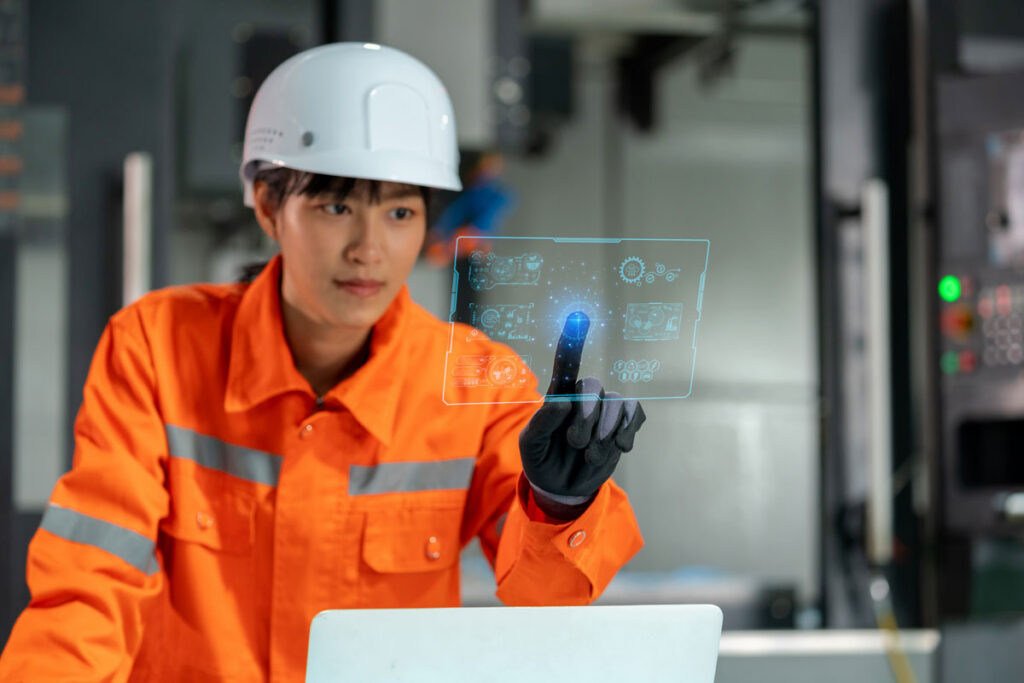
The hype about Artificial Intelligence (AI) for Environmental Health and Safety (EHS) applications is gaining momentum by the day. Vendor websites, analyst reports and blogs just like this one talk of easier reporting, smarter insights and efficiency gains in a variety of tasks and operational processes. Yet, why do many EHS leaders remain skeptical?
It could be that the stakes in EHS are too high. EHS leaders could feel uncomfortable delegating important work to something they don’t understand. Or, they might think their organization isn’t ready for AI.
In all likelihood it’s a combination of these factors, but the reality is that almost every EHS leader is facing pressure to leverage AI in their operation.
Though there are real, tangible benefits of AI in EHS today, the teams that best understand its limitations and its strengths as an augmentative tool will have the most successful rollouts.
AI can deliver real benefits in EHS today
When supported with the right data, reliable oversight, and given the right job, AI can achieve impressive results. For example, AI is great at:
- Pattern recognition to identify near misses and unsafe conditions that might go unreported or see hidden trends in data
- Information synthesis to comb through millions of sources of regulatory language near-instantly and flag relevant updates
- Generative guidance and feedback to help infrequent EHS software users fill out forms more completely and accurately and even probabilistically determine effective next steps after an event or finding
- Conversational queries to make it easier to produce an answer, a document or an analysis.
The stakes in EHS are higher than most
If AI is so capable and compelling, why are so many EHS teams cautious to embrace it? As mentioned, there are multiple reasons.
First, the stakes. Think of AI in EHS like Waymo autonomous cars in a busy city. The wonder over their ability to navigate intersections and crosswalks disappears after a single accident or close call. There is zero tolerance for mistakes.
Likewise, EHS practitioners know that blaming AI for regulatory fines, operational disruption, reputational damage, serious injury or death is unacceptable – one AI-caused mistake is too many.
AI can support decision-making, but it cannot accept liability, stand up to a regulator or explain operational trade-offs to leadership. Accountability must sit with humans.
EHS data isn’t always the cleanest
AI largely relies on an abundance of “good” data to accurately create reports, identify trends or run calculations. Most EHS professionals will say they struggle to gather enough good data from observation programs or near misses to accurately predict risk. Or, they collect high volumes of data that isn’t necessarily uniform or digestible.
Demand to use AI can outpace organizational readiness
Significant preparation is required to maximize value from AI. Data needs to be available and clean. In a given workflow, the roles and responsibilities for both humans and AI need to be explicit. Continuous improvement programs need to be stood up. Employees need to be trained on how (and how not) to use the tools. Many organizations haven’t considered these items, instead opting to do them at the same time as the rollout – that’s a recipe for disaster.
AI is built by humans and humans are biased
Data analysis may feel objective, but recommendations are shaped by how models are designed, trained and prompted. Human bias can influence what AI prioritizes, what it overlooks or how it frames “best actions” for different roles, regions or work groups. Identifying and mitigating bias in EHS requires active governance.
Black-box behavior leads to general discomfort
Even if everything feels right, people hesitate to trust AI because they don’t understand how it works. It’s rational to doubt AI if the logic behind outputs isn’t transparent. In EHS, teams require traceability. They want to see the source, understand the assumptions and validate the chain of custody behind insights. Without that, AI can feel like a curtain hiding the process, even when the output looks reasonable.
How to gain value from AI in EHS
Successfully embedding AI in EHS is not like flipping a switch. It’s a maturity journey that is part organizational, part technical and part cultural. Companies seeking to deploy AI to drive EHS outcomes should:
- Meet AI where it is today. AI is okay in some areas, but excellent in others. EHS teams should determine what they’re asking AI to do and if it’s suited for the job.
- Determine the ultimate goal. Don’t use AI for the sake of it. Identify goals. Understand what success looks like, and then explore how AI can help. It’s critical to lay out a clear plan, decide how to measure success, and adjust the strategy accordingly as you go.
- Ensure transparency. AI tools should show their work. If pulling from the web, sources should be readily available. If building a report, raw info should be a click away. This transparency is important to build trust initially and may also be important for auditors or executives down the line.
- Set up governance before rolling out AI. It is imperative to define what AI is and isn’t allowed to do. It’s also smart to consider review gates in high-consequence decision points, and ensure teams are set up to continuously validate AI performance and monitor accuracy and effectiveness.
- Be prepared. Before launching an AI project, determine if the data is ready. Is the EHS and/or IT team proficient in improving how AI handles relevant use cases? Within those use cases, are the roles of AI and employees clear? Is adequate funding available? Does it align with the broader digital strategy?
EHS professionals should not make a Waymo-like jump to trust and adopt AI. They don’t need to buckle their seatbelt and hope. However, just like other EHS tools, it must be used properly to achieve the best results.
No matter where they are in their journey, Sphera can help EHS professionals apply AI responsibly and effectively to achieve their goals and contribute to a safer, more sustainable, more productive world.