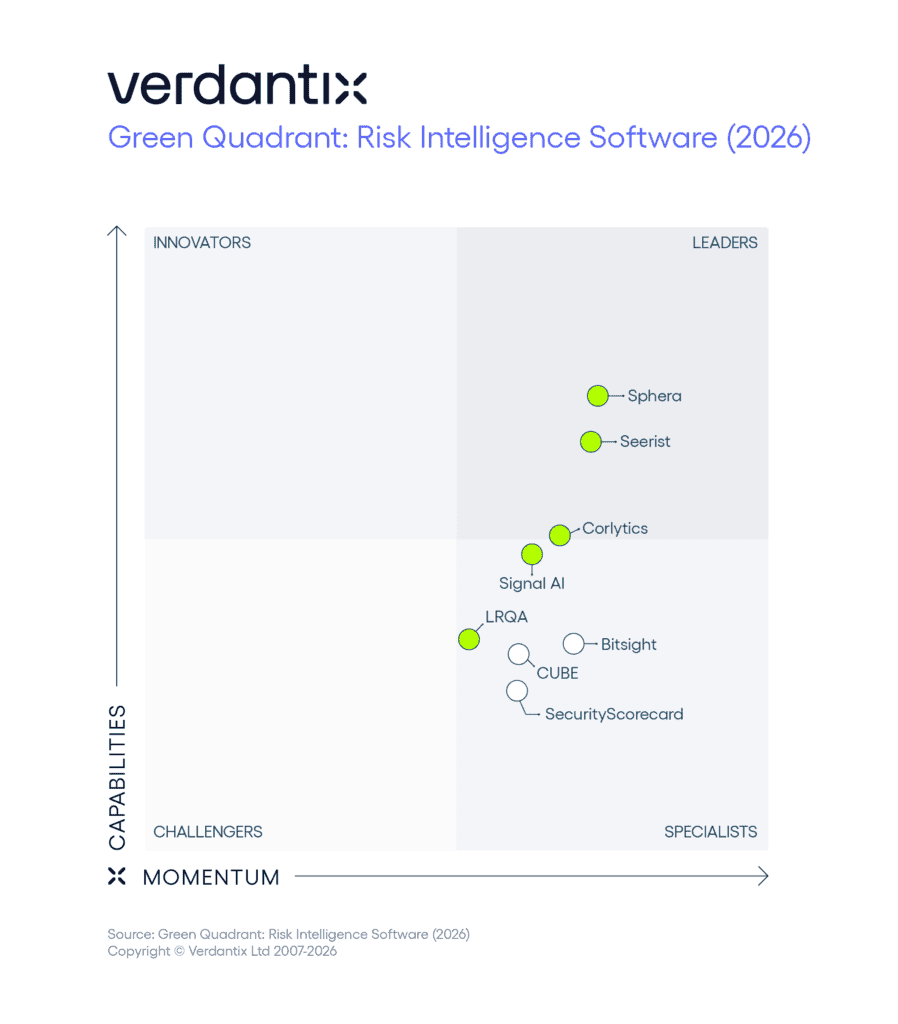
Sphera Named a Leader in the 2026 Verdantix Green Quadrant for Risk Intelligence Software
Sphera Editorial Team
Enterprise risk is changing. Risk teams are still responsible for understanding internal controls, incidents and compliance. But the threats that can disrupt operations increasingly originate outside the organization: across supplier networks, regulatory jurisdictions, geographies and digital ecosystems.
That is why risk intelligence is becoming a more important capability for enterprise buyers.
We are pleased to announce that Sphera has been positioned as a Leader in the 2026 Verdantix Green Quadrant: Risk Intelligence Software. In its inaugural assessment of this market, Verdantix identified Sphera as offering one of the most comprehensive risk intelligence software capabilities.
An independent assessment of a growing market
Verdantix evaluated eight risk intelligence software providers using its Green Quadrant methodology. The assessment included a 120-point questionnaire, two-hour live product demonstrations, buyer interviews and desk research.
Vendors were evaluated across 12 capability categories and 11 momentum categories, including:
AI integration
Data access, management and quality control
Insight and analysis
Coverage and delivery of notifications
User and graphical interfaces
Product strategy, partnerships and customer success
Market vision and business strategy
For buyers, this provides an independent view of a market that is rapidly becoming increasingly relevant to risk, supply chain, operations, compliance and security leaders.
Risk is becoming more connected
One of the most important findings from the research is not about any individual vendor. It is about the operating environment enterprises now face.
Risk intelligence software combines external data feeds, expert insight and technology to identify patterns, correlations and anomalies that may signal emerging threats. This matters because organizations are managing a wider range of interconnected exposures, from geopolitical developments and regulatory change to supplier disruption, cyber threats, climate events and reputational issues.
Consider the scale of the challenge. The report notes that the average firm has approximately 3,000 suppliers for every $1 billion in spend. And the risk does not stop with direct suppliers. A disruption several tiers upstream can affect the availability of critical materials, production capacity, customer commitments and financial performance.
The market also shows a clear maturity gap. Verdantix found that nearly half of surveyed risk leaders still rely on manual internet research for risk intelligence—or have no formal mechanism at all. At the same time, more than 60% plan to increase risk-intelligence budgets over the next 12 months. For buyers, the message is clear: the opportunity is not simply to add another data feed, but to replace fragmented, reactive monitoring with intelligence that can inform operational decisions at scale.
Why Sphera was positioned as a Leader
Verdantix describes Sphera as providing reliable risk intelligence across multiple domains, supported by robust AI integration and advanced data-collection protocols.
The assessment highlights three areas in particular.
1. Near-real-time intelligence built around relevance
Risk teams do not need more noise. They need the ability to identify and prioritize developments that could affect their business.
Verdantix highlighted Sphera’s near-real-time monitoring capabilities, which use AI for event detection, enrichment, de-duplication and relevance scoring. High-priority risks can be dynamically prioritized and routed through customer-defined thresholds and role-based alerts.
This matters because a risk signal only becomes useful when it reaches the right person, with enough context to inform a decision.
2. AI-supported insights with human validation
For enterprise risk management, speed and confidence must work together.
Verdantix recognized Sphera’s approach to combining AI-augmented outputs with structured human validation. Confidence-based workflows route signals through automated quality checks or human-in-the-loop review before delivery, while outputs and classifications can be logged for review.
For buyers, this is an important consideration. AI can help enterprises process a large volume of external information, but risk decisions require transparency, governance and the ability to understand how intelligence was produced.
3. Risk intelligence beyond the direct supplier
The greatest exposure is not always visible at Tier 1.
Verdantix notes that Sphera supports nth-party risk analysis across strategic, operational, financial, geopolitical, regulatory, reputational, climate and cyber risk. The platform processes approximately 15 billion data points from multiple sources, with live deployments spanning around 60,000 suppliers and more than 200,000 supply paths.
That breadth helps organizations move beyond a supplier list toward a more meaningful picture of dependencies and exposure across their value chain.
From risk signals to decision-ready intelligence
The report reinforces a distinction that matters for every enterprise buyer: collecting intelligence is not the same as using it effectively.
Organizations already have access to an enormous volume of information. The harder questions are:
Which suppliers, sites, products or operations could be affected?
How significant is the potential impact?
Which teams need to respond?
What action should come next?
A geopolitical event may create a sourcing issue. A sourcing issue may become an operational constraint. A regulatory development may affect supplier eligibility. A cyber event may disrupt a critical third party.
Managing each issue in isolation makes it harder to see its true business significance. The value of risk intelligence comes from connecting external developments to the operational decisions that matter most.
What buyers should look for
As enterprises assess risk intelligence software, they should look beyond the number of data sources or alerts a solution can provide. The more important question is whether the technology can help teams turn external signals into action. That includes the ability to:
Monitor a broad range of risk domains
Map signals to suppliers, products, facilities and supply paths
Prioritize risks based on relevance and potential impact
Apply AI with strong controls, auditability and human oversight
Deliver intelligence through the workflows and systems where decisions are made
The goal is not simply to see more risk. It is to make better decisions before risk becomes disruption.
A Leader today—and building for what comes next
We are proud to be positioned as a Leader in the 2026 Verdantix Green Quadrant: Risk Intelligence Software.
But the significance goes beyond a position on a quadrant. It reflects a broader shift in how enterprises need to manage operational risk. Supply chain resilience, sustainability, compliance, safety and enterprise risk are increasingly connected—and so are the decisions required to manage them.
Sphera helps organizations connect risk, safety and sustainability insights across operations, products and supply chains. By transforming complex information into decision-ready intelligence, we help enterprises build the visibility and resilience needed to act with greater confidence.
Download the Verdantix Green Quadrant: Risk Intelligence Software (2026) to explore the market landscape, compare 8 leading providers and see the independent assessment of Sphera.