German


Automate & scale LCA, PCF and EPD generation
Manual LCA doesn't scale across portfolios, slowing reporting, increasing compliance risk, losing market access. Automation and AI mapping turn months into minutes, with data consistency.
Request a demo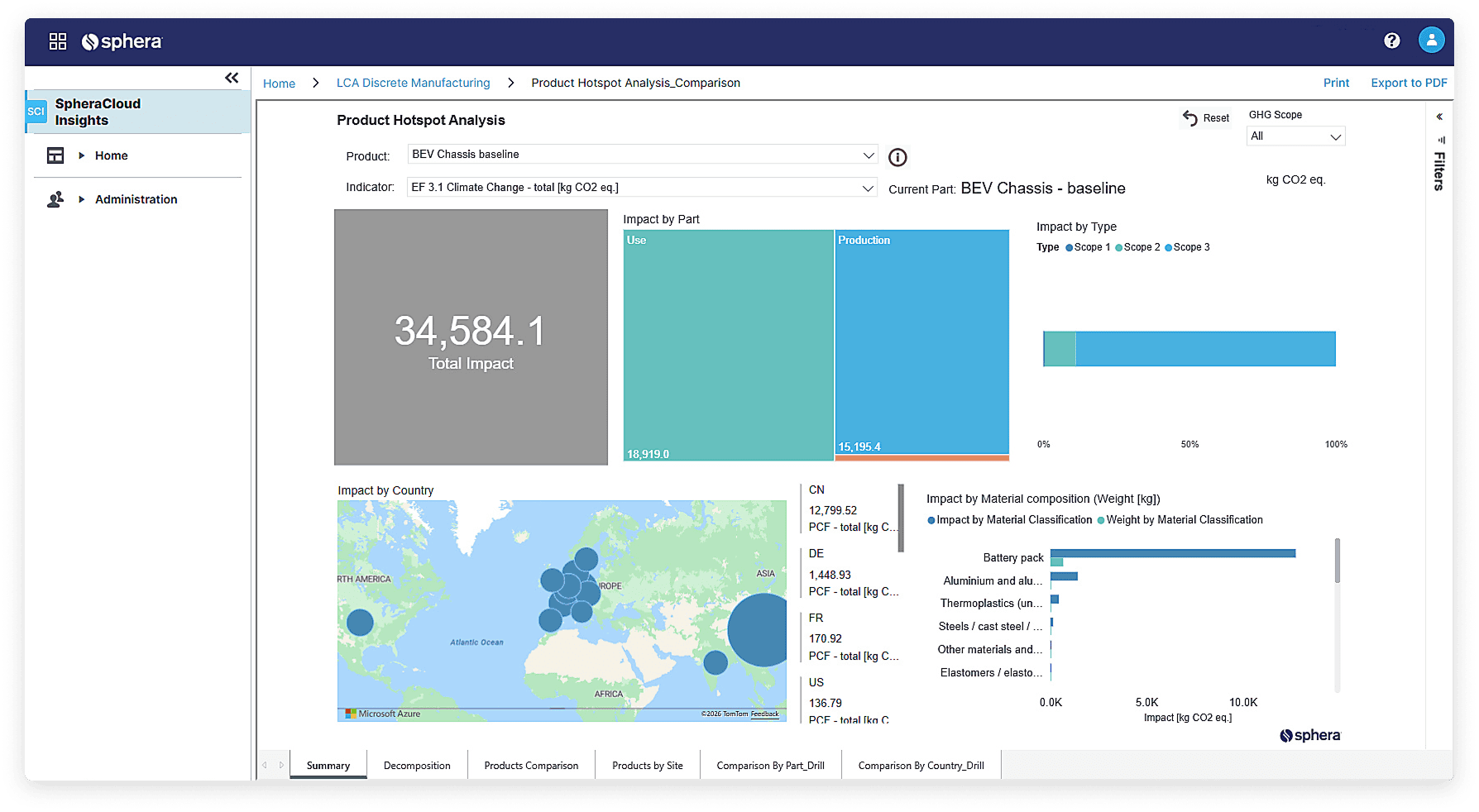
01 — CONNECT
Your product and enterprise data
Integrate your product structures, BOMs, formulations, recipes, ERP, PLM, supplier and manufacturing data.
PLM ERP BOM Supplier Manufacturing
02 — MAP
To our trusted environmental database
AI-powered mapping matches your data in minutes, so you just review and accept each match.
03 — CREATE
A transparent LCA model
Automatically create product-specific LCA models with full traceability and transparency, turning hours of modeling into minutes.
04 — GENERATE
Traceable, audit-ready results
Every output is documented and consistent, ready for reporting, verification and regulatory review.

Automated, not a black box
You still see how each individual product LCA model is created and how each result was calculated. The process is standardized and fully automated, so it’s consistent and easy to audit no matter how many products you’re assessing.
The problem with manual LCA
Doing LCA product by product doesn’t scale. Every new product means repeating the same manual data prep and modeling work, which slows down reporting and makes it harder to keep results consistent across a large portfolio. As more regulations require product-level data, that manual approach becomes the bottleneck, and the exposure isn’t just operational. Falling behind on ESPR, CPR or customer disclosure requirements can mean lost market access, not just slower reporting.
Instead of repeating manual work for every product, organizations can use LCA Automation to:
Scale LCA, PCF and EPD generation
Assess more products without redoing the manual work each time
Save time with automation and AI
Automation and AI-powered data mapping cut down the repetitive data prep and modeling that keeps expert time away from higher-value analysis
Keep results consistent and traceable
Standardized methods mean every assessment holds up the same way under audit or customer scrutiny, regardless of who ran it
Respond to requirements faster
ESPR, CPR, Digital Product Passports, EPD programs and customer procurement requests all move faster when the data is already connected
Enterprise LCA Automation vs. manual and project-based LCA
Manual and project-based LCA work well for a single product or a one-off assessment. They start to break down once you’re covering a large portfolio, multiple business units, or ongoing regulatory reporting.
| Manual / Project-Based LCA | Enterprise LCA Automation | |
|---|---|---|
| Data handling | Data is gathered and entered manually for each product | Data connects directly from ERP, PLM, BOM and supplier systems |
| Scalability | Each new product means repeating the process from scratch | Standardized models apply across as many products as needed |
| Consistency | Results can vary depending on who runs the assessment | The same methodology applies every time |
| Speed | Weeks to months per assessment | Automated mapping and modeling cut turnaround time significantly |
| Best suited for | A single product, a one-time study, or early-stage exploration | Ongoing reporting across a full product portfolio |
| Regulatory readiness | Requires manual updates as requirements change | Built to keep pace with ESPR, CPR and PCF requirements at scale |
Project-based LCA still has a place, often as the right starting point for a first assessment or a small product line. Enterprise LCA Automation is built for scaling across dozens or hundreds of products without the manual effort compounding each time.
How Sphera helps you scale
Trusted environmental data
Built on Sphera’s DEKRA-verified Managed LCA Content, covering over 20,000 environmental datasets, 500+ plant models and roughly 500,000 emission factors.
Enterprise data integration
Connects ERP, PLM, product, supplier and manufacturing systems so data isn’t scattered across teams, giving you one connected foundation for product sustainability data.
Standardized methodologies / workflows
Applies lifecycle methodologies aligned with ISO 14040/14044 and, where relevant, EN 15804 or PEF requirements, through governed workflows across products, sites and business units, so results stay consistent no matter who runs them.
Expert lifecycle modeling
Built by Sphera’s LCA practitioners with 30+ years of lifecycle assessment experience, so the standardized models behind the automation reflect real modeling judgment, not just computational shortcuts.
Lifecycle consulting and implementation expertise
Sphera’s sustainability consultants help define methodologies, assess data readiness, configure models, support verification and get the system running across complex enterprise environments.
AI-powered data mapping, with expert oversight
Matches your product and material data to trusted environmental datasets automatically, while keeping mappings visible for review so your team can accept the suggested mapping or disregard it before results are finalized.
Hotspot and contribution analysis
Identifies high-impact components, materials, suppliers and processes, so reduction efforts go where they’ll have the greatest effect.
Automated LCA, PCF and EPD generation
Runs lifecycle calculations and reporting across large portfolios automatically, reducing the repetitive expert effort needed per assessment while keeping output volume high.
Meeting regulatory and customer requirements
Ecodesign for Sustainable Products Regulation (ESPR) and Digital Product Passports (DPP)
Generate consistent product sustainability data that lines up with what ESPR and Digital Product Passport rules require, reducing the risk of losing market access as these requirements phase in.
Construction Products Regulation (CPR)
Produce the product-level environmental data and EPDs that CPR requires for construction products and materials.
Product carbon footprints (PCFs)
Generate PCFs at scale to keep up with customer, OEM and supply-chain requests without falling behind.
Audit-ready documentation
Every assessment follows the same standardized process, so results hold up under third-party verification, customer audit, or regulatory review, not just internal reporting.
Built for complex industries
FAQs
Find any answers to your questions about LCA Automation Software.
Does LCA Automation replace our LCA practitioners?
No. It removes repetitive data prep and modeling work so your team can focus on review, interpretation and edge cases instead of manual data entry. Practitioners still control methodology decisions and mapping review.
How is the environmental data verified?
It’s built on Sphera’s Managed LCA Content, which is verified by DEKRA, an independent certification body.
Can this handle formulated products, not just discrete BOMs?
Yes. It supports formulations and recipes as well as standard BOM structures.
Can our team review the AI-generated data mappings?
Yes. Mappings are visible for review, so your team can accept the AI-suggested mapping or disregard it, keeping full oversight rather than relying on fully automated output.
How long does it take to get set up?
This depends on how many data sources you’re connecting and how complex your product portfolio is, worth discussing directly on a demo call.
Ready to see it in action?
See how LCA Automation can generate LCAs, PCFs and EPDs across your product portfolio.